

A master key discussion is more useful when it starts with who should enter each area. Before asking how many keys can be combined, map the doors and the roles that need access. This helps distinguish a convenient key arrangement from an access plan the business can manage over time.
Describe roles rather than copying today’s key ring
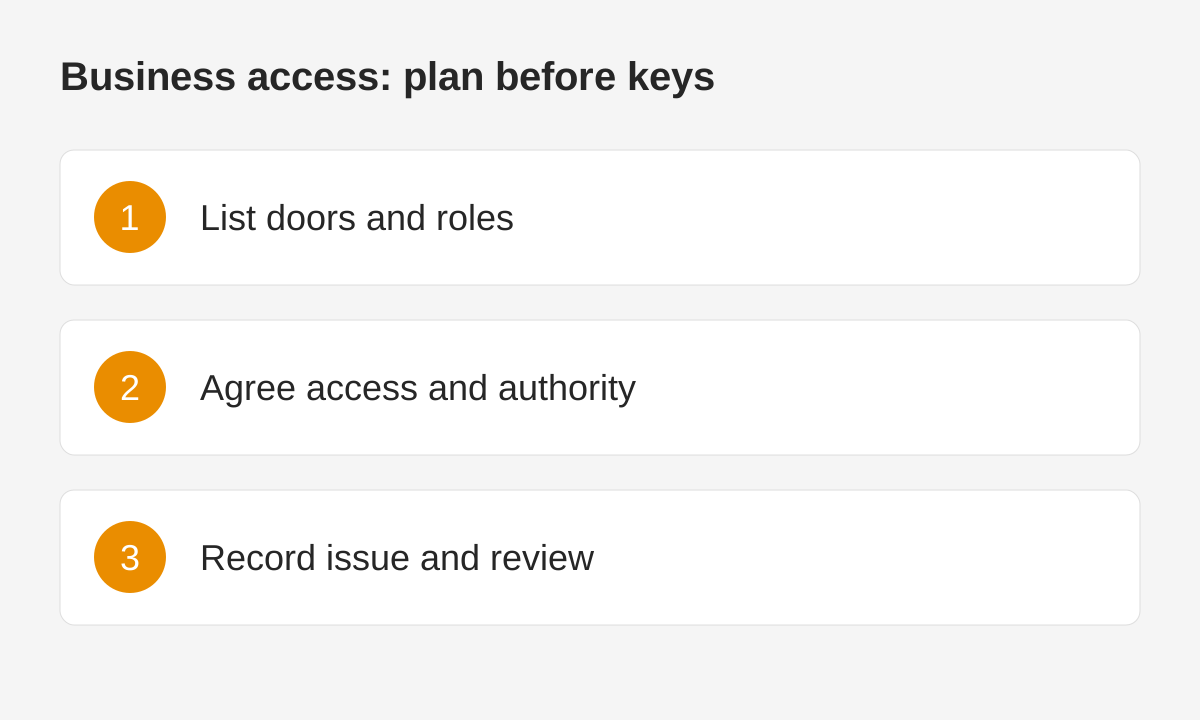
List the main entrance, office, storage room, staff area, and other relevant openings. Then identify roles such as manager, employee, cleaner, or maintenance contractor. Record the access each role actually needs. The result is a planning document, not an instruction to alter a lock yourself.
| Area | Questions to answer |
|---|---|
| Main entrance | Who needs access, and who approves changes? |
| Office | Does every employee need entry? |
| Storage | Should access be restricted to particular roles? |
| Maintenance areas | How will temporary contractor access be managed? |
Document the existing hardware
Record the door count and known lock information. Note failures separately: a door that will not close, a loose cylinder, or a key that works inconsistently. Ask the locksmith to inspect compatibility before treating existing cylinders as reusable.
Access planning must preserve safe exit. Changes involving exit hardware or electronically controlled doors need appropriate professional assessment; a key hierarchy alone is not a complete door-security design.
Plan for a missing key before issuing it
Ask what the business should do if a key is lost, who can request duplicates, and how issued keys will be recorded. Discuss the potential scope of a lost higher-access key. Fewer keys on a ring can be convenient, but the business still needs a clear process for controlling and retiring them.
Keep key schedules and detailed access records private. The staff list displayed on a public website should not double as a map of who can open restricted rooms.
Turn the plan into a consultation
BG Locksmith’s master key system service describes master key planning for Bowling Green businesses and checking existing cylinders. Bring your door-and-role list to the discussion, then ask for a written scope covering the hardware, keys, testing, and any exclusions.
Confirm who is authorized to approve the work and how future additions would be handled. Ask whether the proposed arrangement can accommodate expected staffing or space changes without assuming that every future opening can simply be added.
Review after handover
Before distributing keys, compare the agreed access schedule with the demonstrated result. Record who receives each key and store the business’s service documentation securely. Review the plan after staff departures, a lost key, or a change in how rooms are used.
Ownership disclosure: This website and the service provider linked in this article share ownership. The reference is not an independent review. Confirm service availability and charges directly with the provider.
Frequently asked questions
Can a master key plan be promised from a door count?
No. Access roles, hardware compatibility and authorization need assessment before the scope can be agreed.
What if a higher-access key goes missing?
Follow the agreed incident procedure and contact the provider promptly to assess the affected access. Keep issue records current.
Related: Moving In? Make a Door and Key Inventory Before Calling a Locksmith · All frequently asked questions